Wednesday, 8 June 2016

Classification of Electric Drives

Group Drives

Group Drive
Photo Credit - http://mechaholic.in
It consists of single machine which actuates several machines or mechanism by means of one or more line shaft. Hence this is also called "line shaft drive". This line shafts are connected to multi stepped pulleys and belts that connect this pulley and shaft of the driven machine, serves to vary their speed.

Group drive is economical in consideration for the cost of motor and control gear. A single motor of large capacity costs less than that of the total cost of number of small motors for same total capacity namely, a single motor of 100KW costs less than that of ten motors of 10KW each. Since all the motors may not operate on full load at the same time, the KW rating of motor of group drive is often less than the aggregate KW output rating of the individual motor and further cause reduction in cost.

Individual Drive

Individual Drive
Photo Credit - http://mechaholic.in
In individual drive an electric motor used for transmitting motion to various parts or mechanism belonging to single equipment. For example, such drive are used to rotate the spindle, moves the feed and with the help of gears imparts motion to lubricating and cooling pumps in lathe. In application, individual drive consist of motor which is specifically designed to form an integral part of the machine.

In individual drive, the energy is transmitted to different parts of same mechanism by means of mechanical parts like gear, pulley, etc. hence occurs some power loss.

Multimotor Drive
Multimotor Drive
Photo Credit - http://vertassets.blob.core.windows.net/
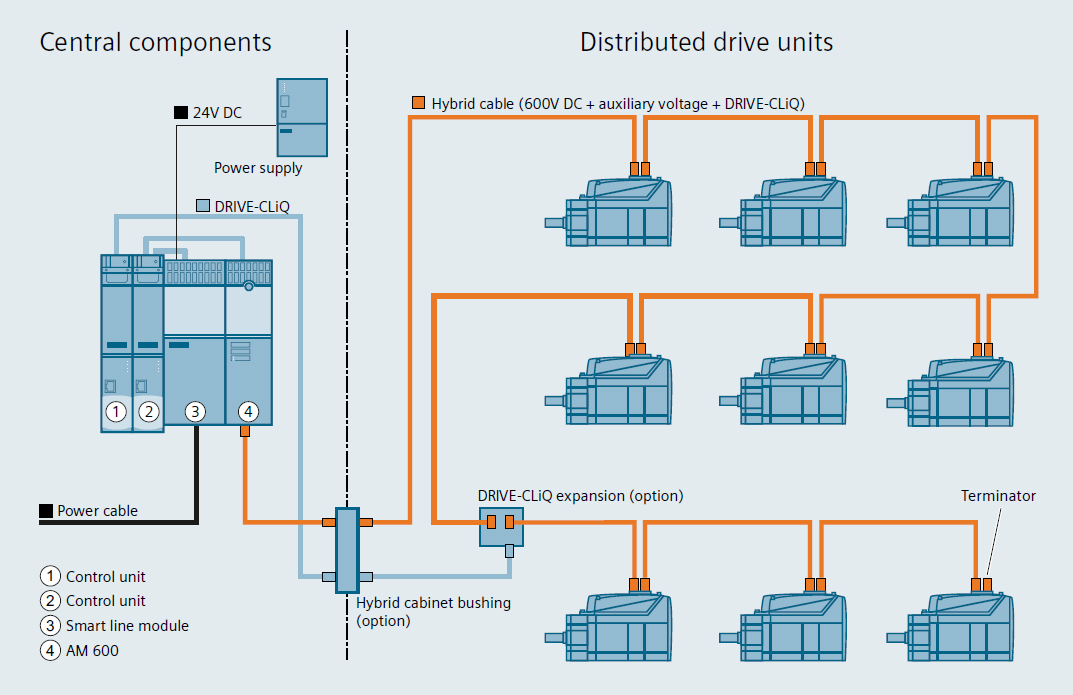
The multimotor drive consist of several individual motor which serve to one of many motions or mechanism in some production unit. For example, in travelling crane, there are three motors used. One for hoisting, other for long travel motion and third for cross travel motion. Such a drive is essential in complicated metal cutting machine, paper making machine, rolling mills, rotary printing machine, etc. The use of multimotor drive is expanding in modern industries due to their advantage outweighs increase in capital cost compared to the group drive.

Tuesday, 7 June 2016

Passive Method of Space Heating

Passive method of Space heating
A schematic diagram of passive space heating designed by Professor Trombe is shown in figure. The south face of the house to be heated is provided with single or double glazing. Behind it is a thick black concrete wall which absorbs Sun radiation and serve as thermal storage. Vent A and B which can be opened and closed are provided near the top and bottom of the storage wall. The whole unit consisting of storage wall with vents and glazing is referred as Trombe Wall.

During day time both vents A and B are kept open. The air between inner glazing and wall is heated and flows into living space from top vent. Simultaneously the cool air in the room is pulled out from the living space through bottom vent. Thus a natural circulation path is set up. Some energy transfer in the living space also takes place by convection and radiation from the inner surface of the storage wall. During night energy transfer take place by convection and radiation from the inner surface.

The Trombe Wall can also be used for summer ventilation by providing vent C and D near the top of glazing and north facing wall. On a hot day, vent B, C and D can be kept open while vent A would be kept closed. The heated air between glazing and wall would then flow out through vent C drawing air from the living space to replace it. This in turn would cause air to be pulled in from outside through vent D. Vent D should be located such that air pulled in through it comes from shaded and cool area. 

Solar Water Heater Working (Thermosymphonic Mode)

Solar Water Heater
Solar Water Heater
A Solar Water Heater(SWH) is a device which provides hot water for bathing, washing, cleaning etc. using solar energy. It is generally installed at terrace or where sunlight is available and heats water during day time which is stored in an insulated storage tank for use when required including morning. It basically heats the water using heat energy of the Sun rays. Today we are going to discuss the working of solar water heater in thermosymphonic mode.
Solar Water Heater (Thermosymphonic mode)

A solar water heater is shown in above figure. It consists of a tilted liquid flat plate collector(LFPC) facing south with transparent glass covers, a separate highly insulated water storage tank and well insulated pipes connecting the two. The bottom of the tank is at least 1-2 feet the top of the collector and no auxiliary energy is required to circulate water through it. Circulation occurs through thermosymphonic mode or natural convection. As the water us heated in its passage through the collector its density decreases and hence it rises and flows into the top of the storage tank, colder water from the bottom of the tank has higher density and so tends to sink and enter the lower header of the collector for further heating.
The density differences between the hot water and cold water thus provides the driving force necessary for the circulation of water through the collector and the storage tank, Hot water is drawn off from the top of the tank as required and is replaced by cold water from the service system. As long as the Sun shines the water will quietly circulate getting warmer. To provide heat, during cloudy periods, an electrical immersion heater can be used as backup for the solar system.

Monday, 11 April 2016

Wireless Power Transfer

First demonstrated by Nicholas Tesla in the 1890s, wireless power transfer is an innovative technology that has permeated major areas in the consumer and industrial electronic market.
The various forms of WPT include solar energy, microwaves, and magnetic energy. In this article, we will focus on wireless power transfer using magnetism and induction coils. The following offers an insight into the working principle, features, and applications.

Working principle 

Wireless power transfer works on the inductive power transfer principle, as found in the conventional transformers. The only difference is that while in the transformer the two coils are in very close proximity and contain a ferrite material to increase the coupling, inductive chargers have an air gap between the two coils. The process follows the following procedure:
  • The mains voltage is converted into alternating current, preferably, high-frequency AC

  • This current (the high-frequency AC) is transferred to the coil  via transmitter circuit. This AC induces a magnetic field in the transmitter coil.

  • The induced magnetic field generates a current in the adjacent receiver coil.
Wireless Power Transfer
However, in the earlier applications, the designers faced a challenge; the strength of a magnetic field decreases with distance. The decrease in strength is proportional to the square of the distance from the source. This made it difficult to regulate power and reduced energy efficiency. To solve this, the designers introduced resonance. You acquire resonance by multiplying the capacitance of the plates attached to the ends of the coil with the coil inductance.

Wireless Power Transfer

The introduction of resonators with the same frequency in the sources and receiver coil respectively ensures that the two systems couple magnetically, thus allowing for higher energy transfer efficiency. This means that the power transfer happens over an air gap without the need for metal or other material connection.For this to happen, both the transmitter and the receiving coil must resonate at the same frequency. The generated AC is converted into direct current for charging the battery.However, in cases where the two objects are far apart, power transfer can still be achieved through resonating the two coils at the same frequency. This eliminates the need for perfect alignment.Greater power transfer distances can be achieved by introducing resonant repeaters between the two components.

Advantages

  • Allows for charging of multiple devices. This is achieved by changing the coil geometry, as well as allocating large charging surface areas such as table tops and charging benches.

  • High charging speeds: though at the moment wireless charging offers a slower charging rate than the wired option, advances in resonance and induction technology promises an increased charging rate and improved efficiency in the future.

  • Wireless power transfer allows for greater spatial freedom between the power source and the device. This means that the two do not have to be precisely aligned for power transfer.

  • Eliminating charging cords enables engineers to make compact and watertight devices, thus maximising on safety, and varied use such as in deep-sea applications.

  • Prevents corrosion and sparking by eliminating mechanical connectors and wired contacts.

  • Reduces costs associated with maintaining and replacing mechanical connectors.

Applications

  1. Industrial Applications: Wireless power transfer has seen tremendous applications and value addition to industries. The primary applications include wireless sensors on rotating shafts, wireless equipment charging and powering, and safe and watertight equipment through eliminating charging cords. 
  2. Subsea applications: Though subsea vehicles can self-navigate, human assistance is still required for power supply. Due to the rough terrain, as well as the distance, cabled conductors can prove to be a challenge. WPT comes in handy in these instances.
  3. Charging mobile devices, unmanned aircraft, home appliances and electric vehicles: The charging system the smaller gadgets comes in the form of a charging pad and power benches, where the user places the device such as a mobile phone and electric toothbrushes.
  4. Charging and operating medical implants such as subcutaneous drug supplies, pacemakers, and other implants. WPT, especially with high resonance allows convenient continual charging of these implants without the need for frequent surgeries and the inclusion of external charging ports.
  5. Charging wearables: The convenience of wearables lies in the mobility and convenience. Considering that the wearer has to walk around, the primary problem thus is the charging. Wireless power transfer accords the convenience of charging by eliminating the requirement for cables and connectors.

Wednesday, 23 March 2016

Skin Effect in Transmission Lines

The distribution of current throughout the cross section of conductor is uniform only when the steady current(D.C.) is passing through it. However, an alternating current flowing through the conductor does not distribute normally, rather it has the tendency to concentrate near the surface of the conductor as shown in figure below.
Skin effect

What is skin effect

The tendency of alternating current to concentrate near the surface of a conductor is known as skin effect. 
This results in higher resistance to alternating current that to direct current and is more pronounced as frequency is increased. This is known as skin effect. It causes a larger power loss for a given rms ac than the loss when the same value of dc is flowing through the conductor. Consequently, a qualitative explanation of the phenomenon is given below.

" A conductor could be considered as composed of very thin filaments. The inner filaments carrying current gives rise to flux which links the inner filaments only when as the flux due to current carrying outer filaments enclose both the inner as well as the outer filaments. The flux linkages per ampere to inner strands is more as compared to outer strands. The inductance* of each strand will vary according to its position. Thus the strands near the center are surrounded by greater magnetic flux and hence have larger inductance than that near the surface. The high reactance of inner strands causes the alternating current to flow near the surface of conductor. This crowding of current near the conductor surface is the skin effect. "
With the increase of the frequency the non-uniformity of inductive reactance of the filaments becomes more pronounced, so also the non-uniformity of current distribution. For large solid conductors the skin effect is quite significant even at 50Hz. The analytical study of skin effect requires the use of Bessel's functions.
The skin effect depends upon the following factors:-
  1. Nature of material
  2. Diameter of wire- It increases with increase in diameter of wire
  3. Frequency- It increase with increase in frequency.
  4. Shape of wire- It is less for stranded conductor than solid conductor.
It may be noted that skin effect is negligible when the supply frequency is low (≤ 50Hz) and conductor diameter is small (< 1 cm).

Monday, 21 March 2016

Corona phenomenon in Transmission Lines

Corona phenomenon in Transmission Lines
When an alternating potential difference is applied across two conductors whose spacing is large as compared to their diameter, there is no apparent change in the condition of atmospheric air surrounding the conductors, if the applied voltage is low. However when the voltage on line conductor is raised beyond a certain limit, called critical disruptive voltage, the conductors are surrounded by pale violet glow together with a slight hissing noise and a smell of ozone. This phenomena is called as corona.

In short corona phenomena is the ionization of air surrounding the power conductors. Free electrons are normally present in free space because of radioactivity and cosmic rays. As the potential between the conductors is increased, the gradient around the surface of the conductor increases. Assuming that the spacing between the conductors is large as compared with the diameter of the conductors. The free electrons will move with certain velocity depending upon the field strength. These electrons will collide with the molecules of air and in case the speed is large they will dislodge electron from the air thereby the number of electrons will increase. The process of ionization is thus cumulative and ultimately forms an electron avalanche. This results in localization of air surrounding the conductor and hence corona effect is occurred.

Corona occurrence is therefore defined as a self sustained electric discharge in which the filed intensified ionization is localized only over a portion of the distance between the conductors.
The phenomena of corona is accompanied by hissing sound, production of ozone, power loss and radio interference. The higher the voltage is raised, the larger and higher the luminous envelope becomes and greater the sound, the power loss and radio noise. If the applied voltage is increased to breakdown value, a flash over will occur between the conductors due to the breakdown of air insulation.

If the conductors are polished and smoothed, the corona glow will be uniform throughout the length of the conductors, otherwise the rough points will appear brighter. With d.c. voltage, there is difference in the appearance of the two wires. The positive wire has uniform glow about it, while the negative conductor has spotty glow. For a visual corona the line voltage has to be somewhat higher than critical disruptive voltage and is called visual critical voltage.

Tuesday, 1 March 2016

Turn ON methods of SCR/Thyristor Triggering

A thyristor can be switched from a non conducting state to a conducting state in several ways-

Forward Voltage Triggering (High Voltage)

When anode to cathode forward voltage is increased with gate circuit open, the leakage current of the thyristor increases. Due to internal current multiplication taking place inside, this current increases. As soon as the forward voltage reaches the breakover voltage (VBO), the reverse biased junction J2 will have an avalanche breakdown
VI_Characteristics of SCR
At this voltage, thyristor changes from OFF state to ON state characterized by a low forward voltage across it with large forward current. This type of turn ON may be destructive and should be avoided.

Thermal Triggering ( Temperature Triggering)

Like any other semiconductor, the width of depletion layer of a thyristor decreases on increasing junction temperature. When the temperature of thyristor is high, there is an increase in the number of electron-hole pairs which increases the leakage current. This increase in leakage current causes increase in current amplification factor 1 and 2. Due to the regenerative action, 1+2 may tend to be unity and the thyristor may be turned ON. This is called thermal triggering of thyristor. This type of turn ON may cause thermal runaway and is normally avoided.

Light Triggering (Radiation Triggering)


If light of adequate frequency and intensity is allowed to strike the thyristor junction, then the photons will strike the electrons and increase the number of electron-hole pairs. This leads to instantaneous flow of current within the device and the triggering of the device. For light triggering to occur, the device must have high value of rate of change of voltage (dV/dt).

dV/dt Triggering

With forward voltage across the anode and cathode of a device, junction J1 and J3 are forward biased whereas the junction J2 becomes reverse biased. This reverse biased junction J2 has the characteristic of a capacitor due to charge existing across the junction. If a forward voltage is suddenly applied, a charging current will flow tending to turn ON the device. If the voltage impressed across the device is denoted by V, the charge by Q and capacitance by Cj then,
The rate of change of junction capacitance may be negligible as the junction capacitance is almost constant. If the rate of change of voltage across the device is large, the device may turn ON even though the small voltage appearing across the device is small.

Gate Triggering

This is the most commonly used method for SCR triggering. The injection of gate current by applying positive gate voltage between the gate and cathode terminals turn ON the SCR much before the specified breakover voltage. The conduction period of the SCR can be controlled by varying the gate signal within the specified value of maximum and minimum gate current. Three types of signals can be used for triggering the SCR using gate. They are either a.c. signal, d.c. signal or pulse signal.


Silicon Controlled Rectifier (SCR)

Silicon Controlled Rectifier(SCR)
Silicon Controlled Rectifier or SCR is one of the oldest type of solid state power device. It was invented in 1975 by the General Electric Research Laboratory. It has the highest power handling capacity of all the power semiconductor device. It has four layer construction with three user accessible terminals. SCR is a latching type device that can be turned ON by the gate terminal but once turned ON, the Gate loses control on it.

Important Features

  1. It is latching type device.
  2. It can handle a very large power.
  3. It is a current controlled device because the gate current controls the SCR.
  4. It acts as an open or closed switch.
  5. The ON state voltage drop is very low.
  6. It can handle thousands of ampere of current.

Construction

It is a four layer PNPN device with three terminals brought out for the user, namely Anode(A), Cathode(K) and Gate(G). The Gate terminal is used in ON process. It can be split into two sections of NPN and PNP as shown below,
Construction of SCR(Silicon Controlled Rectifier)

It has three junctions J1, J2 and J3. The anode and cathode are connected to the main power circuit. The gate terminal carries a low level gate current in the direction of gate to cathode. Normally, the gate terminal is provided at the P layer near the cathode as shown in above figure. This is known as cathode gate.

Monday, 8 February 2016

Principle of operation of SCR (Silicon Controlled Rectifier)

Silicon Controlled Rectifier
When the anode voltage voltage is made positive with respect to the cathode, the junctions J1 and J3 are forward biased but the middle junction J2 is reverse biased and only a small leakage current flows from anode to cathode due to the mobile charges. The junction J2, because of the presence of depletion layer does not allow any current to flow through the device. The leakage current is insufficient to make the device conduct. The depletion layer mostly of immovable charges does not constitute any flow of current. The SCR is then said to be in the forward blocking or OFF sate condition and the leakage current is known as OFF state current ID.
Silicon Controlled Rectifier
When the cathode voltage is positive with respect to the anode, the middle junction J2 becomes forward biased but the two outer junctions J1 and J3 becomes reverse biased. This is like two series connected diodes with reverse voltage across them. The junction J1 and J3 do not allow any current to flow through the device. Only a very small leakage current may flow because of the drift the charges. This leakage current is again insufficient to make the device conduct. The SCR is in the reverse blocking state or OFF state and a reverse leakage current known as reverse current IR flows through the device. The width of the depletion layer at the junction J2 decreases with increase in anode to cathode voltage (since the width is inversely proportional to the voltage). If the anode to cathode voltage VAK is kept on increasing sufficiently to a large value, a stage comes when the depletion layer at J2 vanishes. The reverse biased junction J2 will breakdown due to the large voltage gradient across its depletion layer. This is known as avalanche breakdown and the corresponding voltage is called forward breakdown voltage VBO.
Silicon Controlled Rectifier
Because the other junctions J1 and J3 are already forward biased, there will be a free carrier movement across all three junctions resulting in a large forward anode to cathode current through the device. Due to the flow of this anode to cathode forward current, the device is said to be in conducting state or ON state. The voltage drop would be due to the ohmic drop in the four layers and is small typically, 1V.
The anode to cathode forward current must be more than latching current IL to maintain the required amount of carrier flow across the junction; otherwise, the device reverts to blocking state as the anode to cathode voltage is reduced.

Latching Current (IL):- 

It is the minimum anode to cathode current that must flow through SCR to maintain the device in the ON state immediately after it has been turned ON and the gate signal has been removed.

Once an SCR conducts, it behaves like a conducting diode and there is no control over the device. The device continues to conduct because there is no depletion layer on the junction J2 due to free movements of carriers. However, if the forward anode current is reduced below a level known as holding current IH, a depletion region develops around junction J2 due to the reduced number of carriers and SCR is in the blocking state.

Holding Current (IH):-

It represents the minimum current that can flow through SCR and still "hold" it in the ON state. The accompanying voltage is termed as VH. If the forward anode current is reduced below holding current, SCR will be turned OFF. The holding current is defined for zero gate current (IG = 0).

Note:- The ON state of SCR is known as firing or triggering.

Monday, 1 February 2016

Classification of Overhead Transmission Line

Transmission Line
A transmission line has four constants R, L, C and shunt conductance. But generally, three constants R, L and C are considered and they are uniform along the whole length of line. The fourth constant shunt conductance between conductors or between conductor and ground and accounts for the leakage current at the insulators. It is very small in case of overhead lines and may be assumed zero. The capacitance existing between conductors for line or line forms a shunt path throughout the length of line. Therefore capacitance effects introduce complication in transmission line calculation. Depending upon the manner in which capacitance is taken into account, the overhead transmission line are classified as,
  1. Short transmission lines
  2. Medium transmission lines
  3. Long transmission lines

Short transmission lines

A short transmission line is one in which the line voltage is comparatively low (< 20kV) and the length of an overhead transmission line is upto about 50km. Due to smaller length and lower voltages the capacitance effects are small and hence can be neglected. Hence, whenever studying the performance of a short tranmssion line only resistance and inductance of the line are taken into consideration.

Medium transmission lines

The transmission line having length of an overhead transmission line in the range 50-150 km and the line voltage is moderately high (> 20 kV < 100kV) is considered as a medium transmission line. Since the line is having sufficient length and line voltage, the capacitance effects are taken into consideration. For the puropose of calcuklations, the distributed capacitance of the line is divided and lumped in the form of condensers shunted across the line at one or more points.

Long Transmission Line

When the length of an overhead line is more than 150 km and the line voltage is very high (>100 kV), it is considered as long transmission line. For the treatment of such line, the line constants are considered uniformly distributed over the whole length of the line and rigorous methods are employed for solution.

Sunday, 17 January 2016

What is meant by excitation?

"Self Excited vs Magneto". Licensed under PD-US via Wikipedia
Electric generators work on the principle of electromagnetic induction. The essential part of this principle is the magnetic field. The magnetic field is produced from a d.c. power source from an exciter that is part of the generator system. The main requirement for electricity generation as per the basic principle is a magnetic field. The generator while producing electricity also has to produce the excitation current at a constant voltage for the electrical system to work properly. Controlling the magnetic field controls the voltage output of the generator.
The rotor or field coils in a generator produce the magnetic flux that is essential to the production of the electric power. The rotor is rotating electromagnet that requires a d.c. electric power source to excite the magnetic field. This power comes from an exciter.
Exciter is a device that provides a magnetizing current for the electromagnets in a motor or generator. There are two types of exciter, static exciter and rotory exciter. Rotory exciter is an additional small generator mounted on shaft of main generator. It will supply d.c. voltage to the rotory poles through slip ring and brushes. If it is an a.c. exciter, output of a.c. exciter is rectified by rotating diodes and supply d.c. to main field poles.

Friday, 15 January 2016

What is hunting in synchronous machine?/Phase Swinging/Surging

With the extensive use of synchronous machines, the importance of thoroughly investigating the influence of electrical constants such as resistance and reactance, on hunting is obvious. Hunting is a term used to designate the oscillations of the rotating parts of machines when they are accelerated or decelerated with respect to normal speed. It is essentially a mechanical phenomenon and produces pulsations in the current, voltage and power, due to the variations of angular velocity (due to irregularity of torque) or to the electrical operation of the machines; and if the oscillations exceed a certain amount the regulation of the machines becomes unstable and they fall out of step.

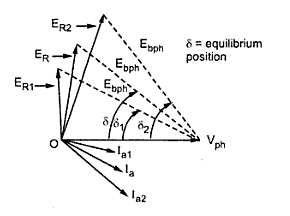
When a synchronous motor is loaded to a varying load, the rotor of the motor falls back by certain angle behind the revolving magnetic field. As the load on the motor is progressively increased, this angle also increases so as to produce necessary torque required to cope up with the load. If the load is suddenly decreased, the motor is immediately pulled up or advanced to a new value corresponding to new load. But in this process the rotor overshoot, hence it is again pulled back. In this way the rotor starts oscillating about its new position of equilibrium corresponding to a new load. If the time period of this oscillation happens to be equal to natural time period of the machine, the mechanical resonance is set up.
Hunting in synchronous machine
The amplitude of these oscillations is built up to a very large value and may eventually become so great that machine is thrown out of the synchronism. This oscillations of rotor about its equilibrium position due to change in load is called hunting. To stop the build up of these oscillations, damper winding are employed which consist of short copper bars embedded in the faces of field pole of the motor. The oscillations of rotor sets up eddy current in the damper winding which flow in such a way so as to suppress the oscillations.
Current variations during hunting
Figure above shows the variation in current during hunting.

Monday, 11 January 2016

Torque Equation of D.C. Motor

In D.C. machine it is seen that the machine torque is uniform for given flux per pole and armature current. Torque is defined as the product of force with its radial distance at which it acts.
T = F × r
But
F = BIL...Newton
where,
B = flux density in Wb/m2
I = current through armature conductor in Amp
L = Length of armature conductor
r = radius of armature drum.
Considering,
P = Total number of poles
Φ = Flux cut per pole in Wb
Z = Total number of armature conductor
A = Number of parallel paths
Ia = Armature current
Flux density formula.jpg
Formula for current in DC Machine

Substituting the values of B and I we get,
Torque equation of DC Motor
Torque Equation of DC Motor.jpg
Since Z are the total number of conductors, therefore total torque is given by
Torque Equation of DC Motor
This is known as torque equation of D.C. motor. But P, Z and A are constant hence,
T ∝ ΦIa
Thus the torque produced by a D.C. Motor is directly proportional to main flux Φ as well as armature current Ia.

Friday, 8 January 2016

Back E.M.F.

What is Back e.m.f. ?

When the armature of a dc motor rotates under the influence of the driving torque, the armature conductor move through the mangetic field and hence e.m.f. is induced in them as in generator. The induced e.m.f. acts in opposite direction to the applied voltage V (by Lenz's Law) and is known as back e.m.f. or counter e.m.f. Eb. The value of back emf depends upon the speed of rotation of armature conductors.

Significance of Back e.m.f.

The presence of back e.m.f. makes the d.c. motor a self regulating machine i.e., it makes the motor to draw as much armature current as is just sufficient to develop the torque required by the load. The back e.m.f. is always less than applied voltage.
Let,
V = Applied voltage
Eb = Back e.m.f.
Ra = Resistance of armature conductor
Then the current in the armature conductor Ia at any instant is given by,
Ia = Net voltage/Resistance
=V-Eb/Ra
OR V = Eb + IaRa 
When the motor is running on no load small torque is required to overcome the friction and windage losses. Therefore, the armature current is Ismall and the back e.m.f. is nearly equal to the applied voltage. If the motor is suddenly loaded the first effect is to cause the armature to slow down. Therefore the speed at which the armature conductors move through the field is reduced and hence the back e.m.f. Eb falls. The decreased back e.m.f. Eallows larger current to flow through the armature and larger current means increased driving torque. Thus, the driving torque increases as the motor slows down. The motor will stop slowing down when the armature current is just sufficient to produce the increased torque required by the load.

If the load on the motor is suddenly decreased, the driving toque is momentarily in excess of the requirement so that armature is accelerated. As the armature speed increase and causes the armature current Ia to decrease as back e.m.f. increases too. The motor will stop accelerating when the armature current is just sufficient to produce the reduced torque required by the load.

It follows, therefore, that back e.m.f. in d.c. motor regulates the flow of armature current i.e., it automatically changes the armature current to meet the load requirement.