Wednesday, 8 June 2016

Classification of Electric Drives

Group Drives

Group Drive
Photo Credit - http://mechaholic.in
It consists of single machine which actuates several machines or mechanism by means of one or more line shaft. Hence this is also called "line shaft drive". This line shafts are connected to multi stepped pulleys and belts that connect this pulley and shaft of the driven machine, serves to vary their speed.

Group drive is economical in consideration for the cost of motor and control gear. A single motor of large capacity costs less than that of the total cost of number of small motors for same total capacity namely, a single motor of 100KW costs less than that of ten motors of 10KW each. Since all the motors may not operate on full load at the same time, the KW rating of motor of group drive is often less than the aggregate KW output rating of the individual motor and further cause reduction in cost.

Individual Drive

Individual Drive
Photo Credit - http://mechaholic.in
In individual drive an electric motor used for transmitting motion to various parts or mechanism belonging to single equipment. For example, such drive are used to rotate the spindle, moves the feed and with the help of gears imparts motion to lubricating and cooling pumps in lathe. In application, individual drive consist of motor which is specifically designed to form an integral part of the machine.

In individual drive, the energy is transmitted to different parts of same mechanism by means of mechanical parts like gear, pulley, etc. hence occurs some power loss.

Multimotor Drive
Multimotor Drive
Photo Credit - http://vertassets.blob.core.windows.net/
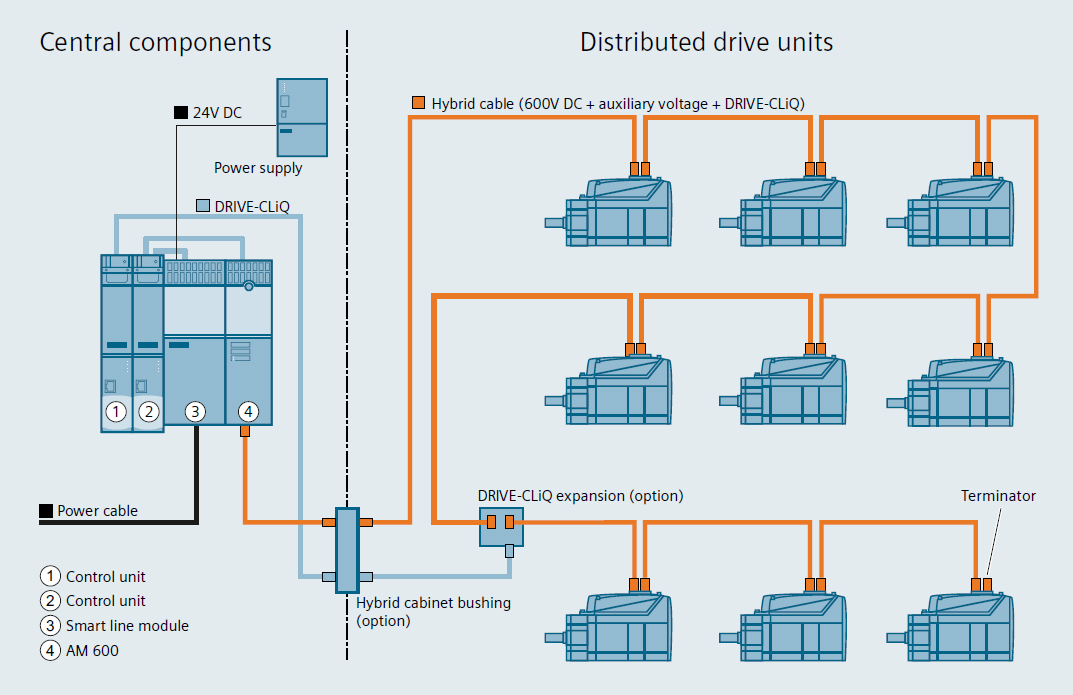
The multimotor drive consist of several individual motor which serve to one of many motions or mechanism in some production unit. For example, in travelling crane, there are three motors used. One for hoisting, other for long travel motion and third for cross travel motion. Such a drive is essential in complicated metal cutting machine, paper making machine, rolling mills, rotary printing machine, etc. The use of multimotor drive is expanding in modern industries due to their advantage outweighs increase in capital cost compared to the group drive.

Tuesday, 7 June 2016

Passive Method of Space Heating

Passive method of Space heating
A schematic diagram of passive space heating designed by Professor Trombe is shown in figure. The south face of the house to be heated is provided with single or double glazing. Behind it is a thick black concrete wall which absorbs Sun radiation and serve as thermal storage. Vent A and B which can be opened and closed are provided near the top and bottom of the storage wall. The whole unit consisting of storage wall with vents and glazing is referred as Trombe Wall.

During day time both vents A and B are kept open. The air between inner glazing and wall is heated and flows into living space from top vent. Simultaneously the cool air in the room is pulled out from the living space through bottom vent. Thus a natural circulation path is set up. Some energy transfer in the living space also takes place by convection and radiation from the inner surface of the storage wall. During night energy transfer take place by convection and radiation from the inner surface.

The Trombe Wall can also be used for summer ventilation by providing vent C and D near the top of glazing and north facing wall. On a hot day, vent B, C and D can be kept open while vent A would be kept closed. The heated air between glazing and wall would then flow out through vent C drawing air from the living space to replace it. This in turn would cause air to be pulled in from outside through vent D. Vent D should be located such that air pulled in through it comes from shaded and cool area. 

Solar Water Heater Working (Thermosymphonic Mode)

Solar Water Heater
Solar Water Heater
A Solar Water Heater(SWH) is a device which provides hot water for bathing, washing, cleaning etc. using solar energy. It is generally installed at terrace or where sunlight is available and heats water during day time which is stored in an insulated storage tank for use when required including morning. It basically heats the water using heat energy of the Sun rays. Today we are going to discuss the working of solar water heater in thermosymphonic mode.
Solar Water Heater (Thermosymphonic mode)

A solar water heater is shown in above figure. It consists of a tilted liquid flat plate collector(LFPC) facing south with transparent glass covers, a separate highly insulated water storage tank and well insulated pipes connecting the two. The bottom of the tank is at least 1-2 feet the top of the collector and no auxiliary energy is required to circulate water through it. Circulation occurs through thermosymphonic mode or natural convection. As the water us heated in its passage through the collector its density decreases and hence it rises and flows into the top of the storage tank, colder water from the bottom of the tank has higher density and so tends to sink and enter the lower header of the collector for further heating.
The density differences between the hot water and cold water thus provides the driving force necessary for the circulation of water through the collector and the storage tank, Hot water is drawn off from the top of the tank as required and is replaced by cold water from the service system. As long as the Sun shines the water will quietly circulate getting warmer. To provide heat, during cloudy periods, an electrical immersion heater can be used as backup for the solar system.