Sunday, 17 January 2016

What is meant by excitation?

"Self Excited vs Magneto". Licensed under PD-US via Wikipedia
Electric generators work on the principle of electromagnetic induction. The essential part of this principle is the magnetic field. The magnetic field is produced from a d.c. power source from an exciter that is part of the generator system. The main requirement for electricity generation as per the basic principle is a magnetic field. The generator while producing electricity also has to produce the excitation current at a constant voltage for the electrical system to work properly. Controlling the magnetic field controls the voltage output of the generator.
The rotor or field coils in a generator produce the magnetic flux that is essential to the production of the electric power. The rotor is rotating electromagnet that requires a d.c. electric power source to excite the magnetic field. This power comes from an exciter.
Exciter is a device that provides a magnetizing current for the electromagnets in a motor or generator. There are two types of exciter, static exciter and rotory exciter. Rotory exciter is an additional small generator mounted on shaft of main generator. It will supply d.c. voltage to the rotory poles through slip ring and brushes. If it is an a.c. exciter, output of a.c. exciter is rectified by rotating diodes and supply d.c. to main field poles.

Friday, 15 January 2016

What is hunting in synchronous machine?/Phase Swinging/Surging

With the extensive use of synchronous machines, the importance of thoroughly investigating the influence of electrical constants such as resistance and reactance, on hunting is obvious. Hunting is a term used to designate the oscillations of the rotating parts of machines when they are accelerated or decelerated with respect to normal speed. It is essentially a mechanical phenomenon and produces pulsations in the current, voltage and power, due to the variations of angular velocity (due to irregularity of torque) or to the electrical operation of the machines; and if the oscillations exceed a certain amount the regulation of the machines becomes unstable and they fall out of step.

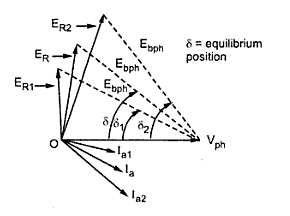
When a synchronous motor is loaded to a varying load, the rotor of the motor falls back by certain angle behind the revolving magnetic field. As the load on the motor is progressively increased, this angle also increases so as to produce necessary torque required to cope up with the load. If the load is suddenly decreased, the motor is immediately pulled up or advanced to a new value corresponding to new load. But in this process the rotor overshoot, hence it is again pulled back. In this way the rotor starts oscillating about its new position of equilibrium corresponding to a new load. If the time period of this oscillation happens to be equal to natural time period of the machine, the mechanical resonance is set up.
Hunting in synchronous machine
The amplitude of these oscillations is built up to a very large value and may eventually become so great that machine is thrown out of the synchronism. This oscillations of rotor about its equilibrium position due to change in load is called hunting. To stop the build up of these oscillations, damper winding are employed which consist of short copper bars embedded in the faces of field pole of the motor. The oscillations of rotor sets up eddy current in the damper winding which flow in such a way so as to suppress the oscillations.
Current variations during hunting
Figure above shows the variation in current during hunting.

Monday, 11 January 2016

Torque Equation of D.C. Motor

In D.C. machine it is seen that the machine torque is uniform for given flux per pole and armature current. Torque is defined as the product of force with its radial distance at which it acts.
T = F × r
But
F = BIL...Newton
where,
B = flux density in Wb/m2
I = current through armature conductor in Amp
L = Length of armature conductor
r = radius of armature drum.
Considering,
P = Total number of poles
Φ = Flux cut per pole in Wb
Z = Total number of armature conductor
A = Number of parallel paths
Ia = Armature current
Flux density formula.jpg
Formula for current in DC Machine

Substituting the values of B and I we get,
Torque equation of DC Motor
Torque Equation of DC Motor.jpg
Since Z are the total number of conductors, therefore total torque is given by
Torque Equation of DC Motor
This is known as torque equation of D.C. motor. But P, Z and A are constant hence,
T ∝ ΦIa
Thus the torque produced by a D.C. Motor is directly proportional to main flux Φ as well as armature current Ia.

Friday, 8 January 2016

Back E.M.F.

What is Back e.m.f. ?

When the armature of a dc motor rotates under the influence of the driving torque, the armature conductor move through the mangetic field and hence e.m.f. is induced in them as in generator. The induced e.m.f. acts in opposite direction to the applied voltage V (by Lenz's Law) and is known as back e.m.f. or counter e.m.f. Eb. The value of back emf depends upon the speed of rotation of armature conductors.

Significance of Back e.m.f.

The presence of back e.m.f. makes the d.c. motor a self regulating machine i.e., it makes the motor to draw as much armature current as is just sufficient to develop the torque required by the load. The back e.m.f. is always less than applied voltage.
Let,
V = Applied voltage
Eb = Back e.m.f.
Ra = Resistance of armature conductor
Then the current in the armature conductor Ia at any instant is given by,
Ia = Net voltage/Resistance
=V-Eb/Ra
OR V = Eb + IaRa 
When the motor is running on no load small torque is required to overcome the friction and windage losses. Therefore, the armature current is Ismall and the back e.m.f. is nearly equal to the applied voltage. If the motor is suddenly loaded the first effect is to cause the armature to slow down. Therefore the speed at which the armature conductors move through the field is reduced and hence the back e.m.f. Eb falls. The decreased back e.m.f. Eallows larger current to flow through the armature and larger current means increased driving torque. Thus, the driving torque increases as the motor slows down. The motor will stop slowing down when the armature current is just sufficient to produce the increased torque required by the load.

If the load on the motor is suddenly decreased, the driving toque is momentarily in excess of the requirement so that armature is accelerated. As the armature speed increase and causes the armature current Ia to decrease as back e.m.f. increases too. The motor will stop accelerating when the armature current is just sufficient to produce the reduced torque required by the load.

It follows, therefore, that back e.m.f. in d.c. motor regulates the flow of armature current i.e., it automatically changes the armature current to meet the load requirement.