Wednesday, 24 December 2014

Diesel Power Station

An alternator requires the mechanical energy as input further it is converted into electrical energy by it. In case of diesel power station, diesel engine acts as a prime mover which obtains its energy from a liquid fuel known as diesel oil and converts this energy into mechanical energy further which is provided to the alternator which is mounted on the same shaft as that of diesel generator. In case of diesel engine heat required for combustion of fuel is obtained by compression of air in the engine cylinder and then the fuel is injected in engine cylinder. The main difference between diesel power station and steam power station is that, in diesel power station, mechanical energy is generated using direct combustion of fuel under use, and in case of steam power stations first combustion of fuel under use is utilized to convert water into steam and then the steam at high pressure and temperature produces the mechanical energy. Diesel power plants are more advantageous than any other heat engine in the view of initial cost, quick starting and stopping time also, it doesn't require any warming up period. Therefore stand by losses are not present and hence has found increasing applications either as continuous or as a peak source of electric power.
Diesel Power Station (Source - Doosan.com)
Although steam power stations and hydroelectric power plant are invariably used to generate bulk power at cheaper costs, yet diesel power stations are finding favour at places where demand of power is less, sufficient quantity of coal and water is not available and the transportation facilities are inadequate. This plants are also standby sets for continuity of supply to important places such as hospitals, radio stations, cinema houses and telephone exchanges.
Block Diagram of Diesel Power Station

Essential element of Diesel Power Plant :-

  1. Engine:- Engine is the main component of the diesel power plant, which develops mechanical power. Generally engine is directly coupled to the alternator. Internal combustion engine are used. An internal combustion engine is that produces power by burning fuel inside a combustion chamber within the engine. The fuel burns and the burnt fuel expands to do work on the moving part inside the cylinder called piston. This movement of piston rotates the flywheel and the engine is directly coupled with the generator. The gases after the expansion inside the chamber is exhausted into the atmosphere and passes through a silencer in order to reduce the noise.
  2. Fuelling System:- It consists of storage tank, strainers, fuel transfer pump and all day fuel tank, heaters and connecting pipe work. To make the oil free from impurities it is passed through the strainers.The fuel oil is supplied at the plant site by rail and road. Heaters for oil may be required in winter season to heat the oil. Fuel is fired into the engine through fuel filter and fuel injection pump.
  3. Air Intake System:- This consists of air filters, ducts and super charger.This system supplies necessary air to the engine for fuel combustion. It consists of ducts/pipes for the supply of fresh air to the engine manifold. Filters are provided to remove dust particles from the atmospheric air which is intended to supply to engine. 
    Air Intake System
    Air Intake System
  4. Exhaust System:-  Exhaust system includes connecting ducts and silencers. This system leads the engine exhaust gas outside the building and discharges it into atmosphere. A silencer is usually incorporated to reduce the noise level. The exhaust system of the diesel power station performs three functions. First system, the exhaust system routes the spent combustion gases away from the engine, where they are diluted by the atmosphere. This keeps the area around the engine habitable. Second the exhaust system confines and routes the gases to the turbocharger, if used. Third, the exhaust system allows mufflers to be used to reduce the engine noise.
  5. Cooling System:- Cooling system includes water circulating pumps, cooling towers or spray ponds and water filtration plant. The heat released by burning of fuel in the engine cylinder is partially converted into work. The remainder part of the heat passes through the cylinder wall, piston, rings etc. and may cause damage to the system. In order to keep the temperature parts of engine within the same operating limits, cooling is provided.
  6. Lubricating System:- Lubricating system includes the oil pumps, oil tanks, filters, coolers, purifiers and connecting pipe work. Lubrication system reduces the friction of moving parts and reduce the wear and tear of the engine parts. The lubrication oil is drawn from the lubrication oil tank by the pump and is passed through filter to remove impurities. The clean lubrication oil is delivered to the points which require lubrication.
    Lubricating System
    Lubricating System (Source-IGNOU)
  7. Engine Starting System:- Engine starting system includes storage battery compressed air tanks, self starters etc. The function of starting system is to start the engine from cold condition. The system enables the engine to route initially while starting until the firing starts and the unit runs on its own power.
  8. Governing System:- The function of the governing system is to maintain the speed of the engine constant irrespective of the load on the plant. This is done generally by varying fuel supply to the engine according to the load. 

Major Components of Diesel Engine

To supply the diesel power station it is worth to know about the diesel engine i.e., its construction and working.
  1. Cylinder:- It is the part of diesel engine in which combustion of fuel is taken place and power is developed. Therefore it is known as heart of the engine. Cylinder has consists of valves through which air and fuel are admitted and exhaust gases are discharged.
  2. Piston:- Power developed by the burning of the fuel is transmitted by the piston to the crank shaft. Distance travelled by the piston from one end to another end is known as. Gas tight seal is required between piston and cylinder liner which is provided by the engine oil lubricated piston rings. 
  3. Connecting rod and crankshaft:- Connecting rod mechanically connects the piston and crankshaft which transfers the mechanical power developed by the piston to the crankshaft. Thus mechanical power generated can be taken out from the crankshaft. 
  4. Fuel Nozzle:- Fuel is delivered by the fuel nozzle in fine spray under pressure in diesel engines.  It mainly consists of fuel pump, fuel line and the injector.
  5.  Camshafts:-  Camshaft is driven from the crankshaft by a timing gear on a chain. It mainly operates the intake valve and the exhaust valve through cam, cam followers, pushrods and rocker arms. 
  6. CrankCase:- Crankcase holds the cylinder, piston and crankshaft.
  7. Flywheel:- Fluctuations of the cyclic variations in speed is reduced by flywheel. It stores energy during power stroke and releases during the other stroke. Thus a constant torque is obtained at output.

Monday, 15 December 2014

HydroElectric Power Station

Energy is required for the overall progress. The natural resources of any country may be large but they can only be turn into wealth  if they are developed, used and exchanged for other goods. This cannot be achieved without energy. The hydro sources are used to generate electrical energy where water resources are available in large quantity.
Adam Beck Complex
Adam Beck Complex
A generating station which utilizes  the potential energy of water at a high level for the generation of electrical energy is known as hydroelectric power station. The energy of water utilized for hydroelectric power generation may be kinetic or potential. Kinetic energy of water is its energy in motion and is a function of mass and velocity while potential energy is a function of the difference in level of water is between two points. In either case the availability of water is a basic requirement. For this purpose water collected in natural lakes and reservoirs at high altitudes may be made use of or water may be artificially stored by constructing dams across flowing streams. Hydro power is considered to be a renewable energy source because it uses the continuous flow of water to rotate the turbine. 

Working 

Layout of Hydroelectric Power Station
In hydroelectric power generation, the water either stored in dam or flowing is made to fall on the turbine blades. The kinetic or potential energy of water rotates the turbine blade. The turbine is coupled with alternator or DC generator. The kinetic or potential energy of water is converted into mechanical energy. We know the basic law that mechanical energy can be converted into electrical energy. Implicating this law the mechanical energy from turbine is converted into electrical energy by the alternator. The generated electrical energy is fed to the transformer and busbar section of the power plant. Then this is stepped up and transmitted to substations via transmission lines. This is the most basic( conversion of some form of energy into mechanical energy and then its converted into electrical energy by alternator/generator) of any power plant either its nuclear/thermal or hydro, etc.

Main function or selection criterion for erecting hydroelectric power plant

  1. Quantity of water available :- Water is the primary requirement of hydroelectric power plant and the availability of huge amounts of water has the most important and greater impact in the generation of electric power. The availability of water can be estimated by using various method, for example by measuring the stream flow over a period as long as possible. By collecting and analysing the previous records of rainfall and minimum and maximum quantity of water available during the year. The losses which may occur  due to evaporation and percolation  is calculated and the net volume of water available for power generation can be determined.
  2. Storage of Water :- We know that the rain does not fall all the time throughout the year (fun fact). So its necessary to store the water by building a dam in order to ensure the availability of water throughout the year for power generation.Storing water has many advantages. The storage helps in equalizing the flow of water so that any excess quantity of water at a certain period of the year can be made available in times of very low flow in the river.
  3. Head of Water :-Availability of head of water has considerable effect on the cost and economy of the power generation. The topography of the area selected for installing the power station is responsible for the available water head.
  4. Cost and type of land :- The bearing capacity of the ground should be adequate to withstand the weight of heavy equipment to be installed. The cost of land available for power plant must be available at reasonable cost. And last but not least the selected should be away from earthquake centers.
  5. Near to load centers :- Owing to minimize the transmission cost the site selected for hydroelectric power station should be located near to load centers. 
  6. Transportation facility :- For the transportation of machinery and equipments the power station should be efficiently connected with rail and road. 

Major Components of Hydroelectric Power Station 

Reservoir , Dam, trash rack, forebay, surge tank, penstock, spillway are some some of the important component of hydroelectric power station. The power house itself has prime movers and generators in addition to the above mentioned components.

  1. Reservoir :- The purpose of reservoir is to store water which may be utilized to run the prime mover to produce electrical power. It is the basic requirement of hydroelectric power station. A reservoir store water during the rainy season and supplies the same during dry season.
    Reservoir - Taum Sauk Hydroelectric Power Station
    Reservoir - Taum Sauk Hydroelectric Power Station
  2. Dam :- A dam may be considered as a large storage bay where water is stored to provide water head. Dam is a barrier; it is built of concrete or earth or rock fill.  
    Upper Wardha Dam
    Upper Wardha Dam
  3. Trash Rack :- The purpose of trash rack is to prevent entry of debris or material which might damage the wicket gates and the turbine runners or mean checking of nozzles of impulse turbine.
    Trash Rack
    Trash Rack
  4. Forebay :- The forebay is similar to reservoir but it is built in small manner. It serves as a regulating reservoir storing water temporarily when load on the plant is increased or reduced. In short it may be considered as the enlarged body of the water just before the intake. 
    Forebay
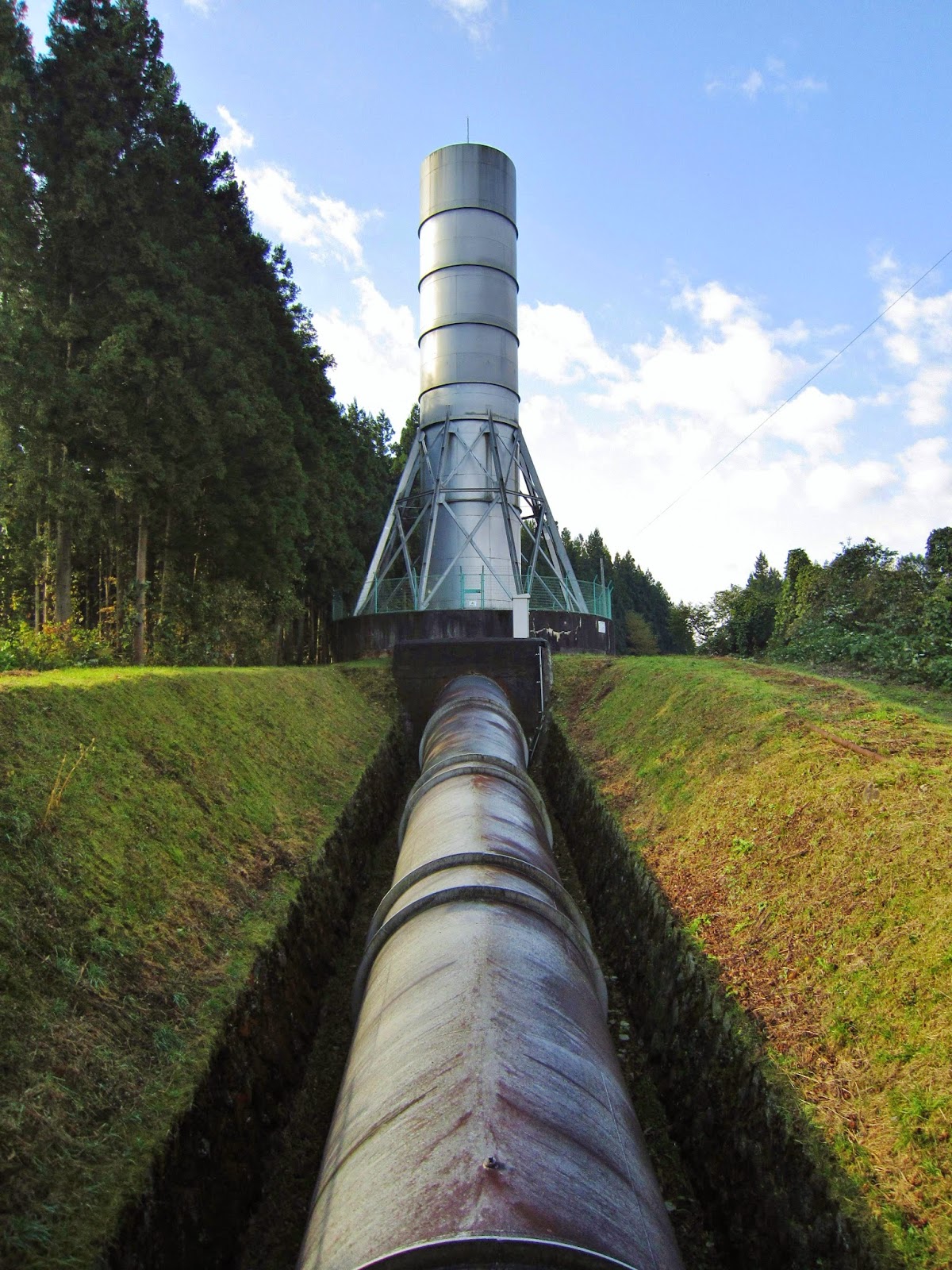
  5. Surge Tank :- To protect the penstock from abnormal pressure surge tank is open at the top and is located near the beginning of the penstock. When the load is steady on the alternator, turbine run swiftly and there is no surge in the flow water through penstock. It can be understood by considering that, when the load is steady the quantity of water flowing through the penstock is sufficient to drive the turbine and meet the load demand. However when the load on the alternator increases or decreases suddenly the governor has to close the gates of the turbine to reduce or increase water supply to the turbine but due to certain time lag the water pressure in the penstock increases or decreases, this may damage the penstock. For avoiding this abnormal condition the surge tank is provided to maintain the flow of water and the pressure in the penstock by increasing or decreasing the water level.
  6. Surge Tank and Penstock
    Surge Tank and Penstock
  7. Penstock :- It is a conduit system which controls the flow of water and for taking water from the intake and forebay to the turbine. The penstock pipes are generally of steel for high and medium head plants, they may be of concrete in low head plants. The diameter and cross sectional area of penstock pipe is dependent on the velocity of water and pressure of water. It is a gate or an enclosed pipe which delivers water from valve house to power house ( hydro turbines ).

Tuesday, 9 December 2014

Nuclear Power Station

Modern world requires large quantity of power at cheap cost. Industrialization and the gradually increasing living standard of human beings has increased to such an extent that the required energy becoming thrice in decade. Nowadays this required demand of power is fulfilled by major contribution of fossil fuels such coal, oil, etc. The studies had estimated and proved  that stock of these fossil fuels will no longer be sufficient and available to fulfill the very fast increasing demand of energy as the reserves of these resources in the world are limited and these will be exhausted soon.With the vision of increase in demand power, an important source of prosperity. For this we need to understand the atomic physics.
Modern World Electricity Requirement - A view from Shanghai

 Atomic Physics

An atom is the smallest particle of a chemical element that can exist. An  atom can be visualized as the tiny solar system of which the the matter is composed. An atom consists of positively charged nucleus surrounded by number of negatively charged electrons. The nucleus contains two types of particles, namely protons and neutrons. Each proton carries unit positive charge while neutrons are uncharged or neutral particles.A normal atom is generally electrically uncharged due to the fact that the number of electrons on the orbits is equal to the number of protons in the nucleus. Thus any addition of electron to the neutral atom makes atom, negatively charged. While recombination of electron to an atom it absorbs energy. Similarly any subtraction of electron will make the atom positively charged, while liberating an electron from atom it releases some energy.This is the most basic of Nuclear Power Generation which we should learn proficiently if we want to gain knowledge of Nuclear Power Station. 

Nuclear Fission

When an unstable heavy nucleus is bombarded with high energy neutrons then it splits into two elements of lower mass number. It also releases huge amount of energy with separation of two or three neutrons at high speed ( 2 × 107 m/sec ). This process is known as fission and the two elements which have separated due to fission have smaller mass number and called as fission products.The fission is always associated with the release of tremendous amount of heat energy which is very important for power development.

Chain Reaction

We already discussed on the above paragraph that how fission take place so now we will discuss about the Chain Reaction. When a slow moving neutron is bombarded on the fuel rods which splits the atom into two parts usually negatively charged electron and two or three neutrons.Each fission ed nucleus ejects two or three neutrons which again hit the remaining fuel and accelerate the splitting process. While separating the electrons, energy is released by the atom. If this process is continuous then it is known as chain reaction.

Working of Nuclear Power Station

Nuclear Power Station (Tarapur)

In nuclear power plant, Uranium U235 or Thorium T232 takes the place of oil, coal and gas to be the fuel used to heat water and produce steam.A nuclear reaction (Chain Reaction) occurs when Uranium atom splits into smaller particles in a chain reaction that produces large amount of heat.The heat producing fission process is controlled in reactors. The core of the reactor contains the Uranium fuel. The fission process take place within the fuel assemblies in the reactor and fuel is shaped and located in such a manner that the heat production within the reactor is uniform.The reaction is controlled by control rods.Control rods, located inside the fuel assembly are made of material which absorb neutron. In addition to control rods, operator use Boron dissolved in the coolant to absorb neutrons to the fission process. The nuclear energy released by fission heats the water or coolant that flows through and the fuel assemblies. In nuclear plants the coolant prevents the core of the reactor from becoming excessively hot and also carries heat energy from the reactor to steam turbine. In nuclear power plant, a vessel known as a pressure keeps the primary side at high temperature to prevent the boiling yet allowing water temperature to reach 500℃. Heat from the primary side water is transferred to the secondary through the steam turbine. Since the secondary water is at a lower pressure than the primary side, the secondary side water boils and steam become steam which rotates the steam turbine.

Main Components of Nuclear Power Station

Nuclear Reactor
Nuclear Reactor
  1. Reactor Core :- The reactor core is that part of nuclear power plant where fission chain reaction is made to occur and where fission energy us liberated in the form of heat for operating power conversion equipment. The core of the nuclear reactor consist of an assembly of fuel rod, control rod, coolant and moderator. The fuel element are made of plates or rods of Uranium or Thorium.
  2. Reflector :- A  reflector is usually a plate around the core to reflect back some of the neutrons that leak out from the surface of the core.It is generally made of same material as the moderator.
  3. Control rods :- It is also known as control mechanism used to start the nuclear chain reaction when the reactor is started from cold. The chain reaction should be maintained at steady state condition at the required level. It is also use to shut down the reactor automatically under emergency condition.
  4. Moderator :- The moderator is a material which reduces the kinetic energy of fast neutron to slow neutron and this is done in a fraction of second.The function of moderator is to increase the probability of reaction.
  5. Coolant :- The main purpose of coolant in the reactor is to transfer the heat generated in the reactor to heat exchanger where steam is generated.
  6. Shielding :- The reactor is a source of intense radiation activity and these radioactive produced are very harmful to human life. Hence the reactor is shielded. The common radiation from the reactors are α rays, β rays, γ rays and fast electrons.